
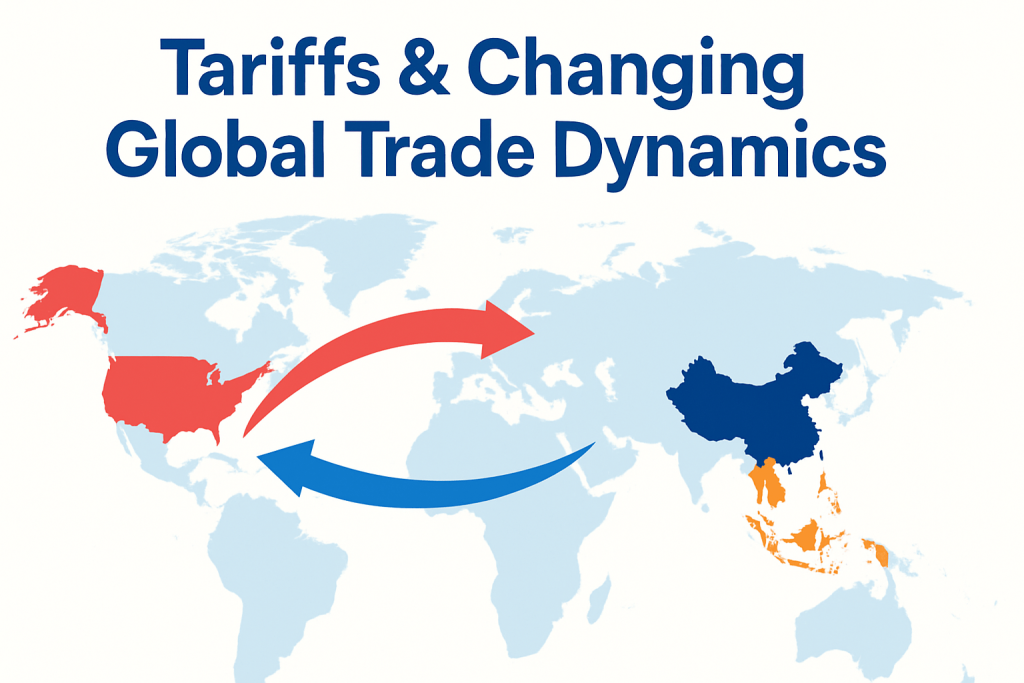
Those of us associated with commerce and business are well aware that ‘tariffs significantly impact international trade dynamics by influencing prices, trade flows, and economic relationships between nations. They can protect domestic industries but also increase costs for consumers and businesses, potentially leading to retaliatory measures and a more complex global trading environment’. Tariffs raise the cost of imported goods, potentially making domestically produced goods more competitive. As per WTO Chief Economist Ralph Ossa, ‘at the most basic level, a tariff is a tax on imported products. It drives a wedge between the world price and the domestic price’.
However, the impact of tariffs is often random and unpredictable as they create an anomalous situation which is inconsistent with market forces. Tariffs can reduce overall trade volumes, raise costs artificially and create inefficiencies in a market. While tariffs are typically a useful trade tool for use temporarily to protect domestic industry allowing it to grow and become competitive, but when continued in the long term, tariffs result in complacency and inefficiency. Both of which are undesirable outcomes.
The world is witnessing a hitherto unheard of aggressive and hostile imposition of tariffs and trade restrictions, ostensibly to protect individual economies. The governments of these countries are convinced that they have borne the brunt of unfair terms of trade causing immense harm to their economic situation and loss of opportunity for their people. Stress in the global value chains of industry has been rising resulting in volatility and unpredictable behaviour by the key players. This trend has been gaining momentum over last few years, maybe from as long as a decade ago, and it has its origins in the 70’s with shifting of industry and economic activity to Asia, especially to China.
This shift has been huge and was reinforced by western economies to utilise China as a low cost and efficient manufacturing base. Relations on the economic front started getting strained when the developed nations realised that China is now taking a leadership position in several emerging technologies. Simultaneously, it is becoming more aggressive in its vision, goals and objectives. There is a global realisation that China is aspiring and within striking range to become the largest and most powerful economy in the world. The power equation has tilted significantly. To add to this, we are all aware of China’s aggressive postures and hostile approach when it comes to achieving its own objectives, strategic, territorial and economic, to ensure it’s leadership and superiority over other nations. Sometimes even at the cost of ignoring principles of world trade and international peace, security and cooperation.
The advent of President Trump has brought a completely new facet to this scenario of strained global value chains. There are the core WTO principles of reciprocity and non-discrimination which Trump has stated as the basis of his tariffs. These two principles are accepted by WTO as effective tools and avoid mutually harmful tariffs. However, the fact is that Trump is shaking the very foundation of world trade in which United States has always, as per our memory, played a key role. As an importer, consumer, tech leader and innovator, the US has provided fertile ground for the world. Even more so as a champion of free trade, allowing among the lowest import tariffs for its huge market. However, that has been flipped over 180 degrees by Trump Tariffs and most countries are trying to figure out how to address the situation. China has been stoic while the US has been volatile, to say the least. Things are yet to settle down and we are all waiting for the 90 days moratorium period announced by Trump to end, and what will be his next move.
Most of us will agree that this is not a desirable situation, hurting most of us, and probably also the United States. India is in a relatively better situation and we are not facing the brunt of the tariff attack. In fact, it is expected that India may benefit from the tariff war between China and the US, as global IT products companies are considering shifting atleast partially, their production from China to India.
‘Counterpoint Research estimates, based on discussions with global companies, that China’s domination in smartphone manufacturing will decline — with its share of global production falling sharply to 55 per cent by 2026 from 64 per cent in 2024 — if tariff impositions and tensions continue’.
However, while India may benefit with its rising share of global smartphone production, this may not be as beneficial as desired, unless we can strengthen our value chain. Let’s differentiate between supply chain and value chain as what is required is not just a seamless supply chain but an eco-system of components, R&D, Innovation and design. Succinctly put, we need to raise our domestic value addition from the current 15-20% to 50% in next 10 years. This means more design and manufacturing of semiconductors, components, materials, products, circuits, frugal solutions, and a supporting eco-system. We must not lose sight of sectors other than mobiles which are equally or even more important for us. There are huge market opportunities as well as strategic importance in segments ranging from consumer electronics, automotive & EV’s, Industry 4.0, IoT, medical technology, information technology on one end and strategic segments on the other including communications, energy, security, space, defence, avionics etc.
So let’s not get miffed and derailed by arbitrary actions of leading world economies. Tariffs are a policy tool with wide-ranging and often unintended, consequences. They may have short term appeal which can blind us to the long term costs such as inflation, competitiveness, lack of international trust and cooperation. Bharat needs to maintain its calm and confidence and march on with good policies and governance to strengthen its economy and become a leader in the world electronics industry.
Rajoo Goel
Secretary General ELCINA


How has China’s shift from a low-cost manufacturing hub to a leader in emerging technologies influenced global economic power dynamics and triggered strategic responses from developed nations?
komunikasi